The Burnout-Informed Coach
For coaches who are noticing something their training didn’t prepare them for.
You’re in session with a high-performing client.
They’re articulate, self-aware, accomplished. They talk about their goals with clarity. They agree to the actions. They say the session was helpful.
Then they don’t move.
Or they move but the progress doesn’t stick.
Or they show up the next session and something feels different. Flatter. More effortful. Like they’re performing engagement rather than actually being present.
You ask a coaching question that should open something up, and they go blank. Not resistant. Not defensive. Blank.
Like the question disappeared before it reached them.
You finish the session. They thank you. You close your laptop. And you sit wondering what just happened.
You’re not new to coaching. You know how to hold space. You know how to ask powerful questions. You know how to work with resistance, avoidance, fear, self-doubt.
But this isn’t that.
This is something else.
And once you start noticing it, you can’t stop.
Here’s where you find out what’s actually happening.
Your clients aren’t just
tired, or a “bit stressed”.
They look high-performing because they’re still delivering. But underneath the polished exterior is a cognitive system that’s compromised, an identity that’s lost, and a body that’s running on fumes.
And when you coach them the way you were trained to coach, using the frameworks that work beautifully with clients with energy, agency and capacity, the tools start to fail.
Goal setting reinforces the performance pressure that’s contributing to the problem. Powerful questions don’t land because their brain can’t process them. Accountability creates another demand for someone already about to crack under the strain. Strengths-based work feels invalidating when the client can’t access their strengths. And action-focused conversations produce a to-do list for someone who’s list is already keeping them awake at night.
Traditional coaching assumes the client ha capacity, sense of self and a regulated nervous system.
Burnout removes all three.
And when those conditions aren’t present, coaching doesn’t just stop working. It can cause harm.
The standard for coaching has changed.
High-performing clients are operating in chronic depletion. Traditional coaching frameworks were not built for this reality.

Here’s what continuing without being burnout-informed is costing you.
You guide a client toward a goal because that’s what coaching does, and you don’t realise that pushing them toward that goal is the thing that’s going to top them over the edge.
A client says “I’m fine”, and you believe them, because they look fine, and three months later they’re signed off wok and you’re replaying the sessions wondering what you missed.
A client agrees enthusiastically to an action, then doesn’t do it, and you frame it is resistance, or a lack of commitment when what’s actually happening is their nervous system is close to ‘shutdown and action feels impossible.
You ask a question that should create insight, and instead it creates overwhelm, and you don’t know how to recover the session because you don’t understand what happened.
You finish a session that felt productive in the moment and lie awake at 3am wondering if you pushed too hard, whether you should have reframed the question, whether the client is ok.
You’re relying on instinct in moments that require expertise.
Instinct is no longer enough.
You need to be able to recognise when burnout is in the room.
You need to know what it’s doing to your client’s capacity to engage with coaching, and how to adjust your approach so you’re working with their reality, not against it.
And right now, you don’t have that.
So you keep coaching the way you were trained, hoping you’re getting it right, knowing something’s off, unable to name it.
And here’s what happens if you stay here.
A client leaves your coaching and you never find out whether the work you did together helped or harmed.
You keep finishing sessions with that niggle, the one that tells you there was more, and you didn’t see it.
You lose confidence in your coaching because you can’t predict when frameworks will work and when they will fail.
You start avoiding the clients who feel harder, and then realise they’re all experiencing similar feelings.
Or worse.
You keep coaching without adjusting, and one day a client tells you the coaching made things worse, and you realise too late what you thought was supporting was actually a contributing factor to the burnout.
Coaching is no longer safe unless it’s burnout-informed.
This is what happens in two days.
You’re in session with the same high-performing client. They say “I’m fine”. But this time, you don’t just hear the words. You don’t push toward the goal.
A client goes blank after a coaching questions. You don’t interpret it as resistance. You recognise what’s happening in the body and the brain, and you adjust the coaching. You don’t ask another question. You slow down the session. You work with the client as they are, not their future self.
A client talks to you about through until the end of the quarter. You hear the strain underneath the determination. You know this isn’t about discipline or commitment. You know the cost of continuing to push. And you have the language to name what’s happening in a way that doesn’t overstep the coaching boundary, or blame, and it helps them to see what they couldn’t on their own.
You know when to challenge and when to hold back.
You know when goal-setting will support the client and when it will cause harm.
You know when a powerful question will create insight and when it will create shutdown.
You know when to stretch and when to refer.
You close your laptop after the session and you know you worked with the whole person. You saw what needed to be seen. You adjusted your coaching to meet the client where they actually were, not where the coaching tools assumed they’d be.
You don’t lie awake wondering if you got it right. You know you did.
This is what burnout-informed coaching does.
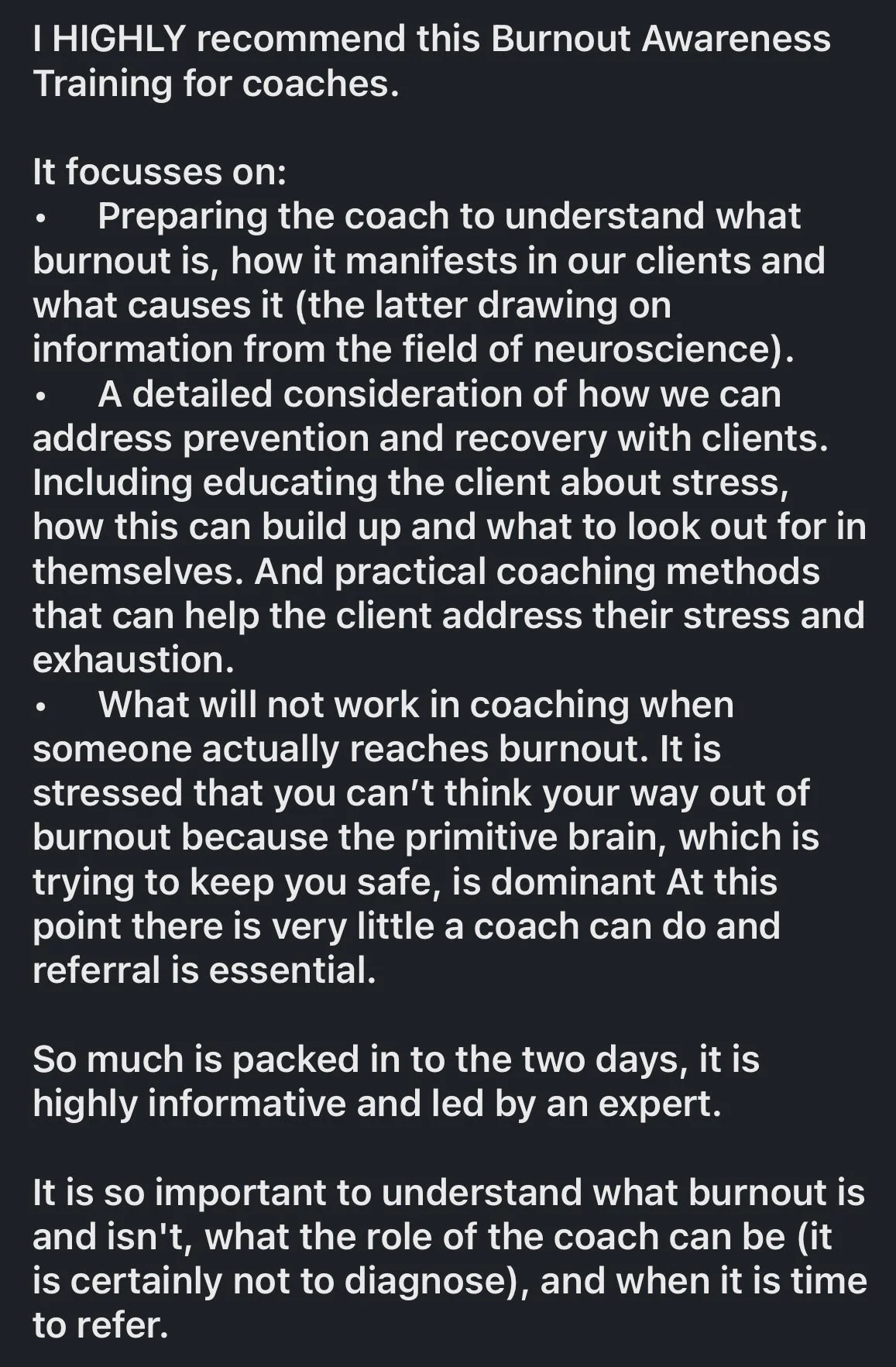
Two days won’t make you a ‘burnout expert, but they do make you a coach who can hold the reality of what your clients are actually living in.
The Burnout-Informed Coach training is the minimum standard for coaching right now.
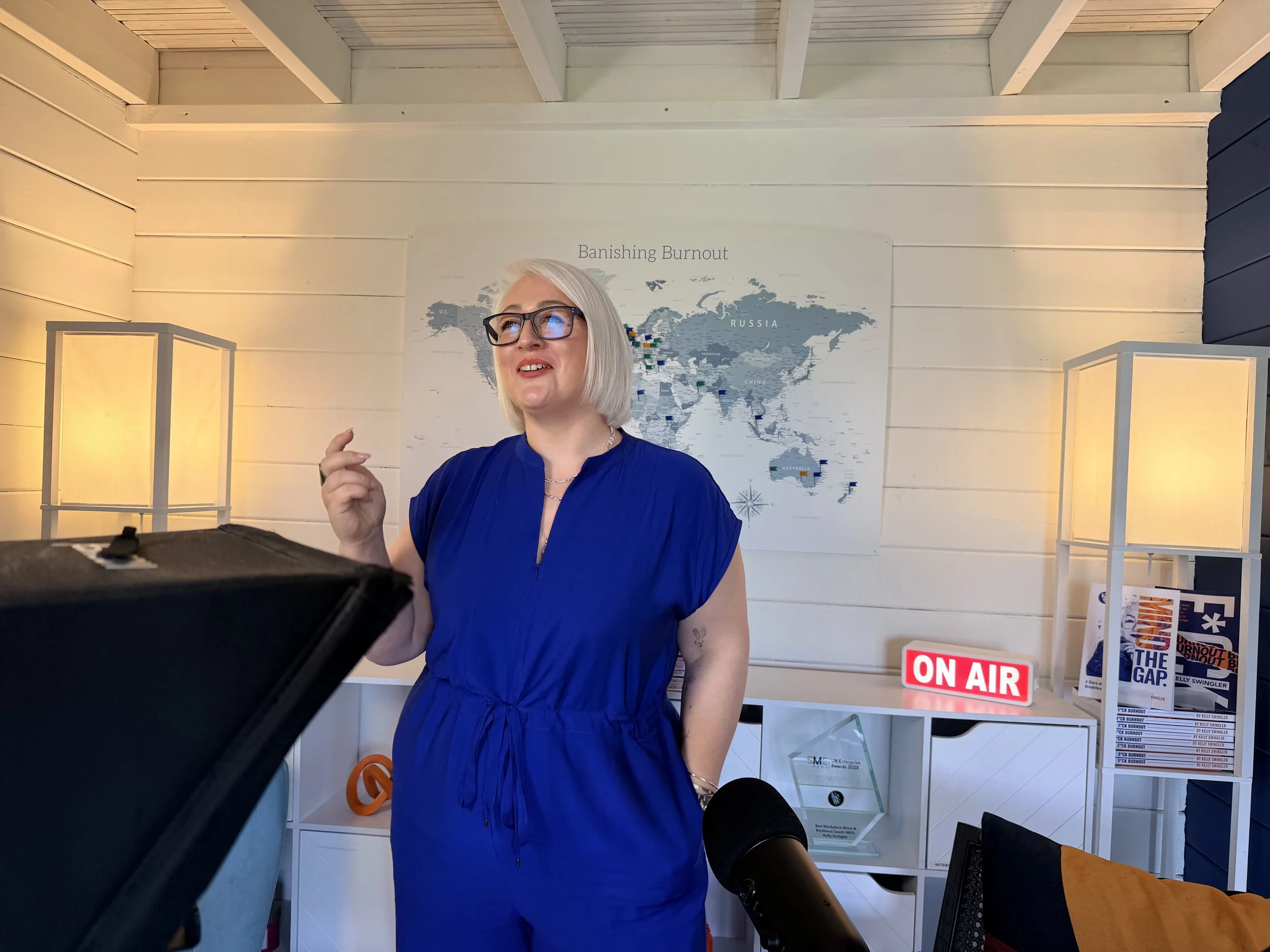
This is what I wish my clients had known before my first burnout made me seriously ill and my second almost killed me.
It’s the foundation. The absolute baseline for coaches who are working with people in the world as it is right now, not as it was when your coaching training was designed.
It’s built on Burnoutology and the Burnout Equation:
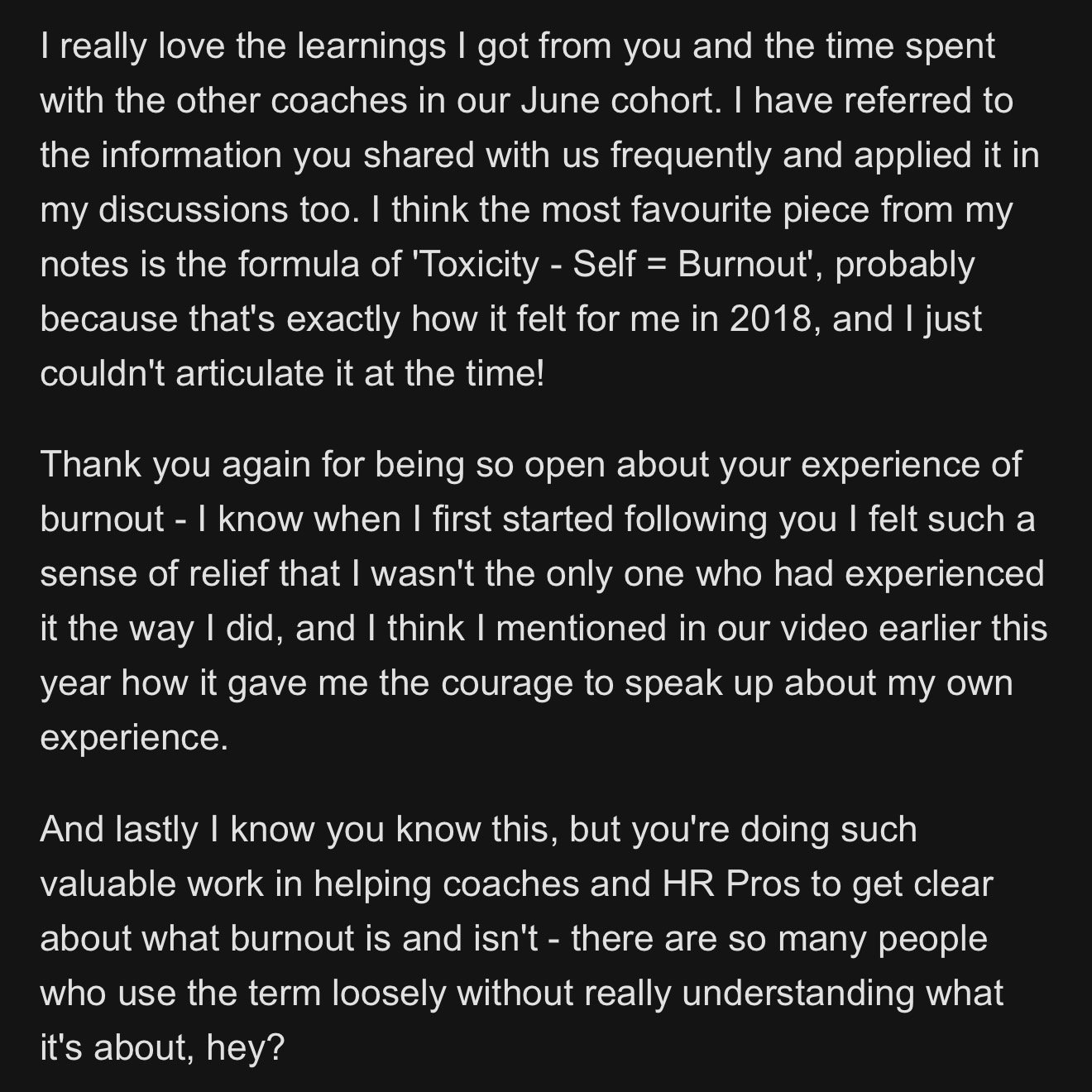
Toxicity - Sense of Self = Burnout
How to recognise burnout even when the clients looks high-performing
Why some capable clients stall, and what that means for your coaching
How to respond when a client says “I don’t know” without pushing them into shutdown
When traditional goal-setting will do more harm than good
How to adjust your coaching so you’re working with the whole person, their cognitive system, their nervous system and their capacity, not just their goals
The tools, skills and techniques that work pre and post burnout
The language of burnout, how your clients are talking about it without even knowing what it is, and how to adapt your coaching in real time
This isn’t theory you’ll figure out how to apply later.
This is designed for real coaching rooms, with real clients, in a way that you can use instantly.
Over the two days you’ll learn:
By dinner on day one, you’ll know this is different.
You’re explaining burnout clearly. WIthout buzzwords. Without hesitation.
It clicks.
Day two is where your coaching changes.
This training is for coaches who:
are already established, with your own ‘niche’ and specialism
want all of your clients to thrive, so you can celebrate their wins and successes during and in between sessions
know that the world of work has changed, but coaching hasn’t
know that stress, chronic stress and burnout are deeply impacting the lives, world and work of clients
know your current coaching no longer feels safe, or effective when burnout is in the room
This is not for:
coaches who want to specialise in burnout coaching (that’s the Master Burnout Coach)
surface-level wellbeing add-ons
lifestyle coaching only
people collecting certificates without changing how they coach
Who this is for
- and who it isn’t.
.
What’s included:
Two-day live intensive, 10am to 5pm UK, via Zom
Burnout-Informed coach accreditation (you have three months to complete the accreditation after the training, with personal feedback from me)
Three months FREE access to the Burnout Coach Collective for additional learning, answers and feedback.
Once accredited, a FREE listing on the website as a Burnout-Informed Coach for 12 months from the date of the training. This is where I refer the coaching enquiries I receive.
Investment £1250
Two days. Live. Intensive. Burnout-Informed.
The culmination of 12 years of study, work, research, and 700 leaders coached through burnout.
This is coaching redesigned for the reality your clients are living in.
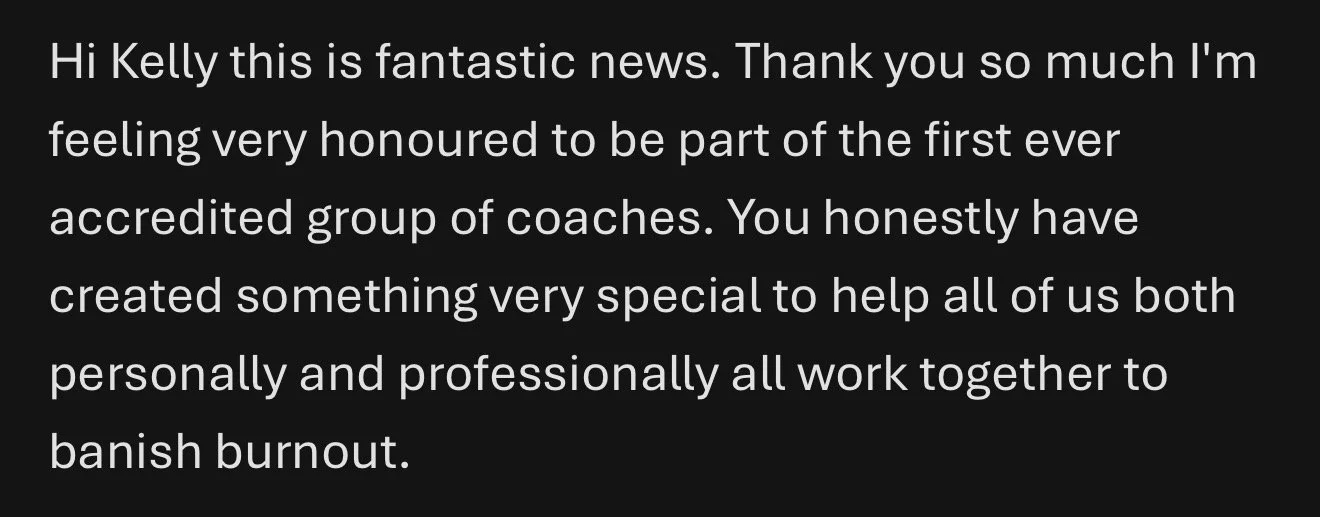
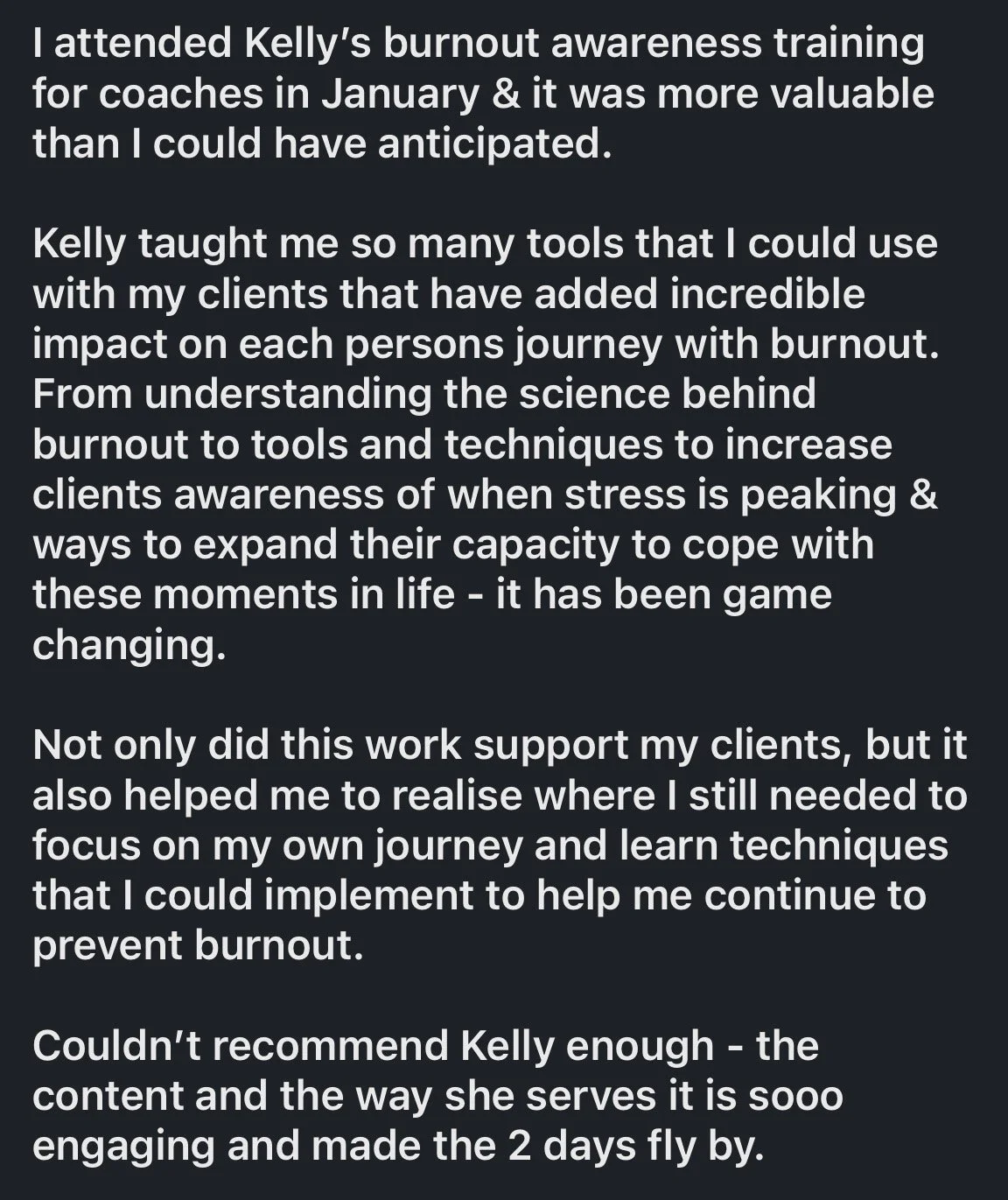
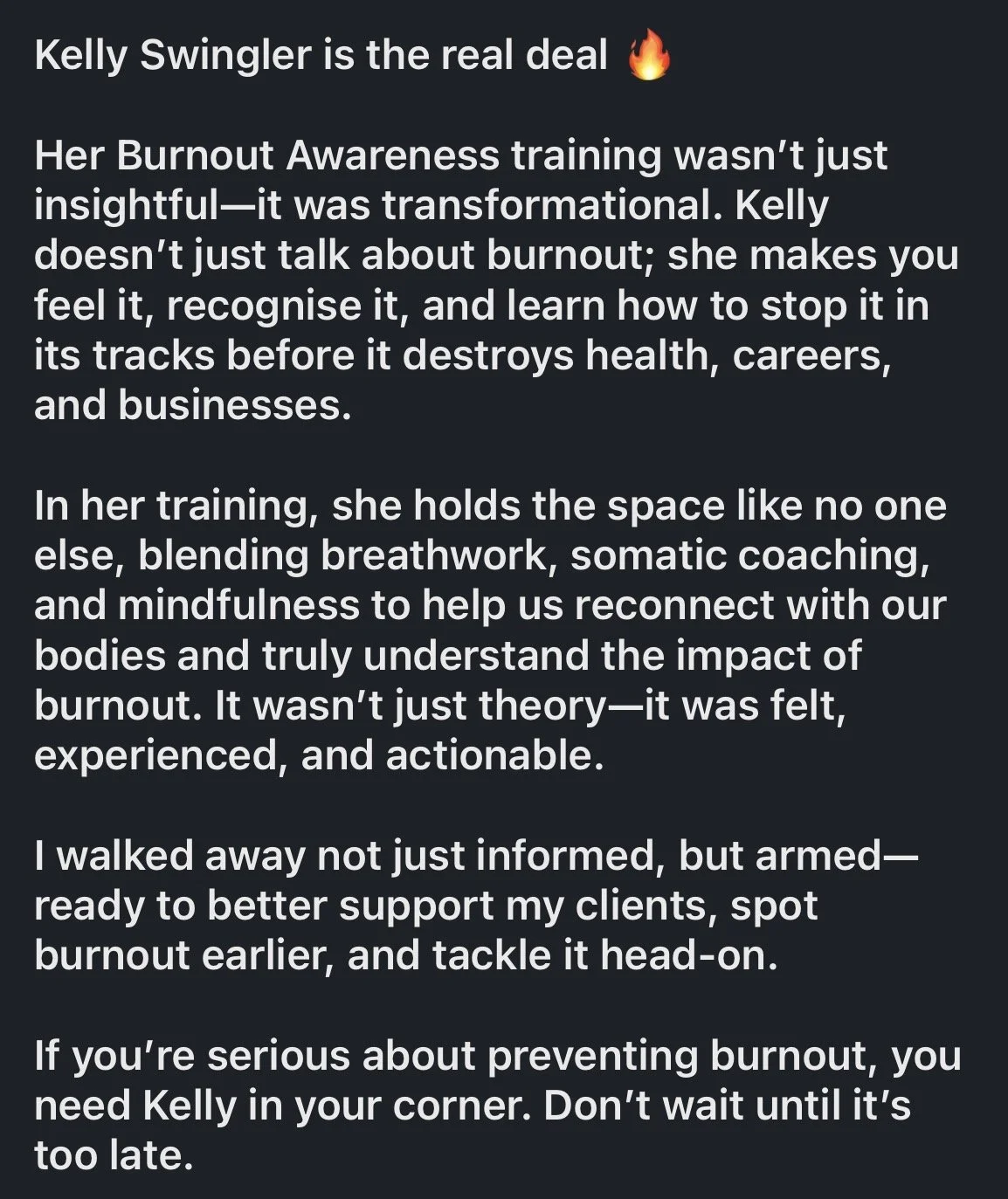
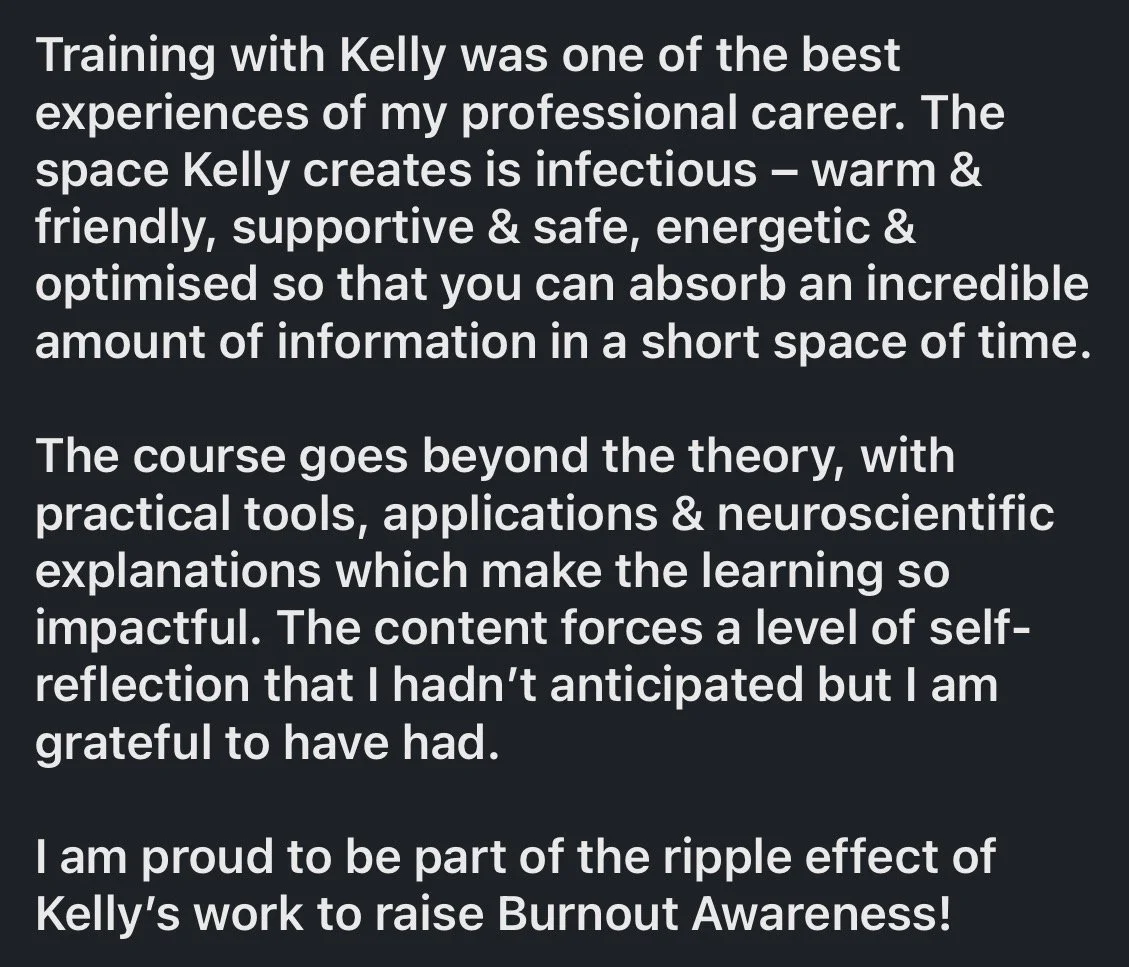
WHAT THE ALUMNI SAY.
-
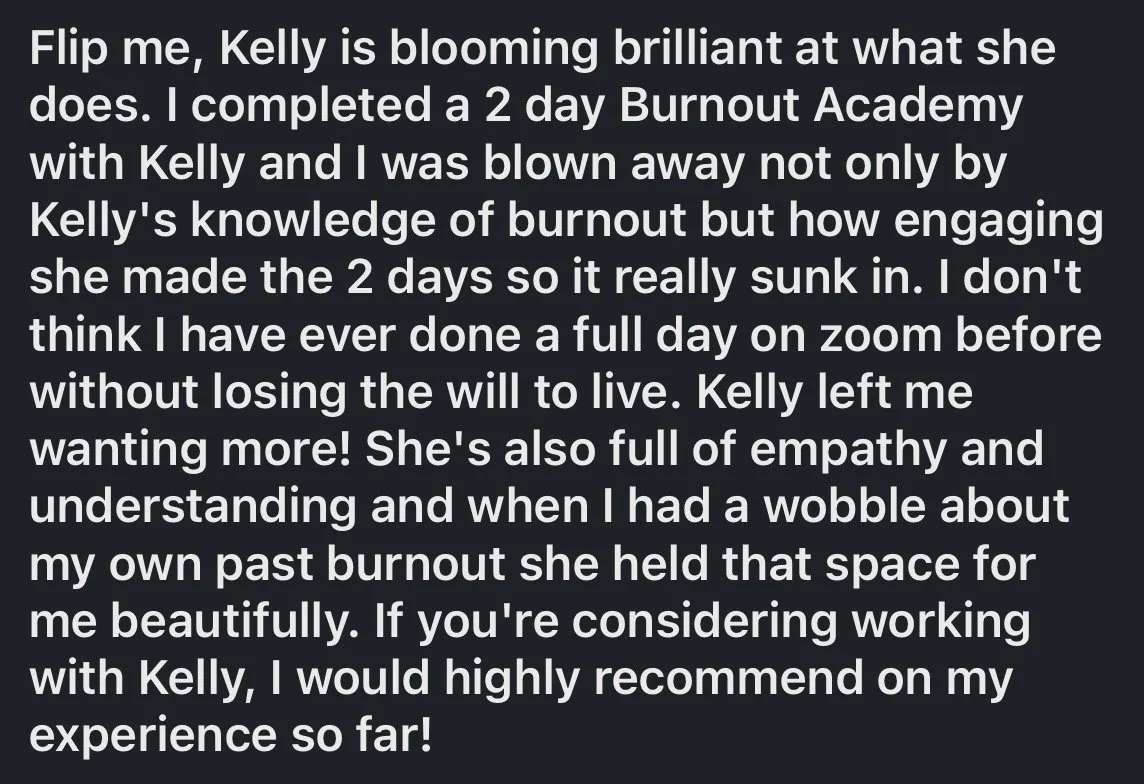
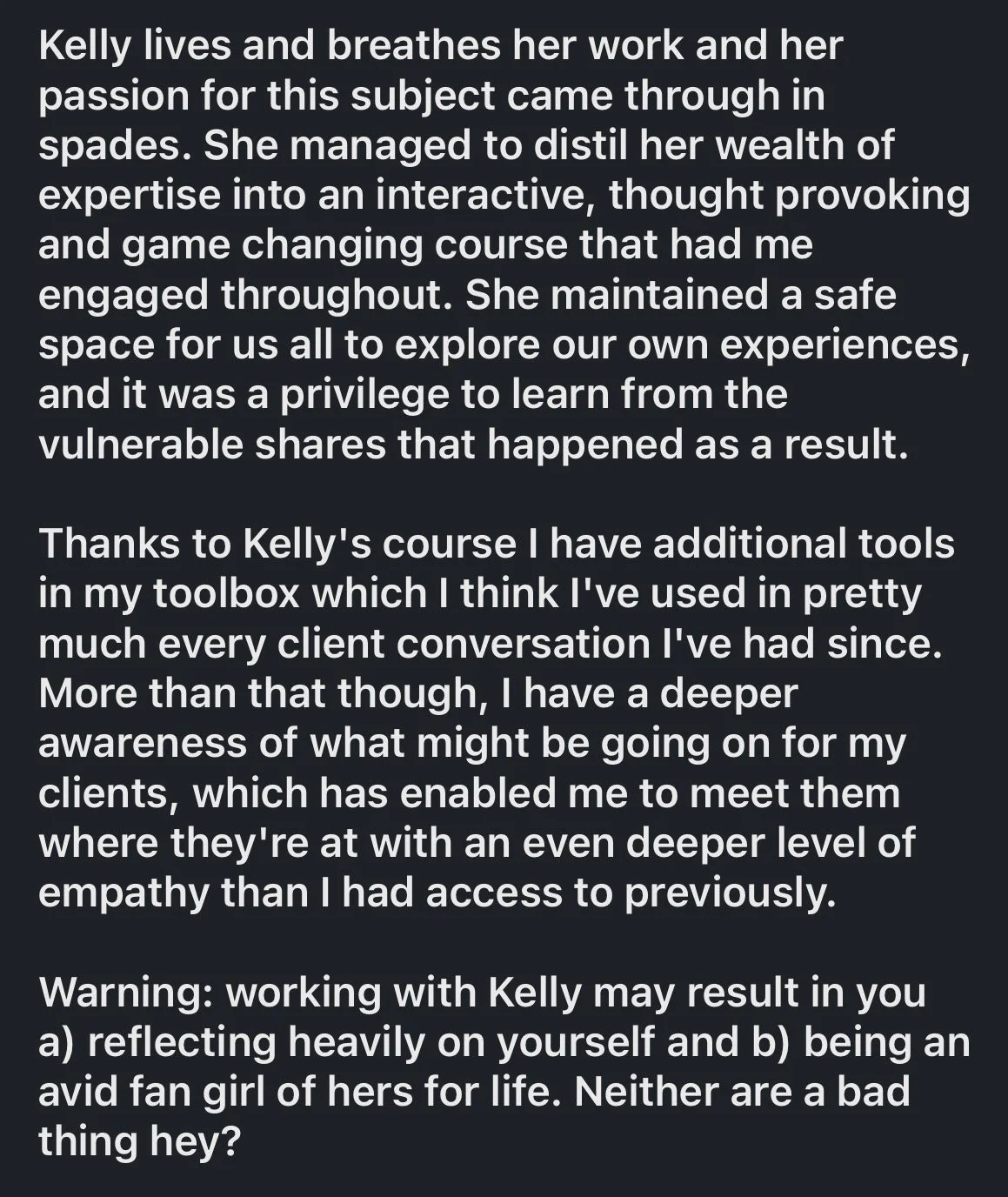
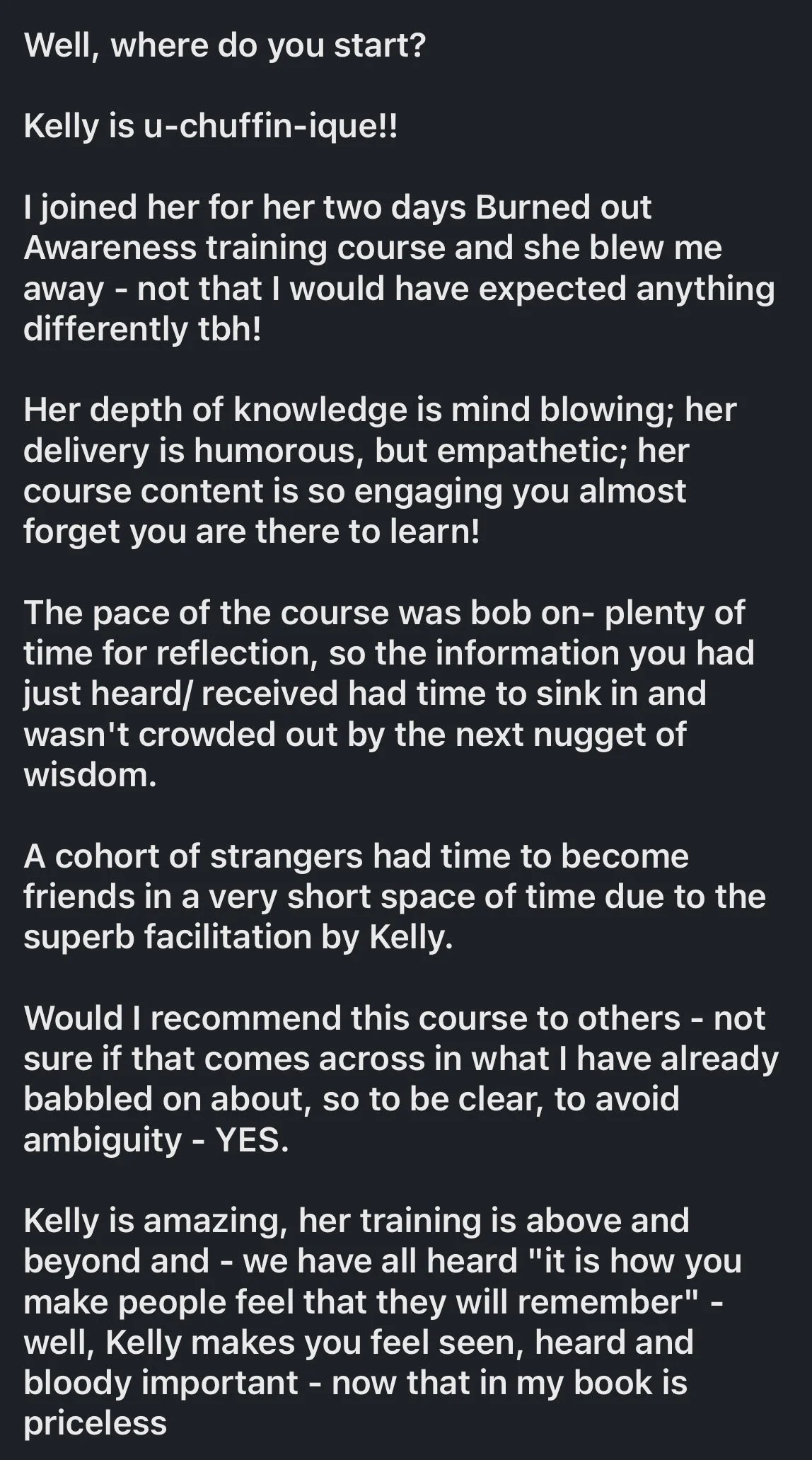
I completed a 2 day Burnout Academy with Kelly and I was blown away not only by Kelly's knowledge of burnout but how engaging she made the 2 days so it really sunk in. I don't think I have ever done a full day on zoom before without losing the will to live. Kelly left me wanting more! She's also full of empathy and understanding and when I had a wobble about my own past burnout she held that space for me beautifully. If you're considering working with Kelly, I would highly recommend on my experience so far!
Amy Wilkinson.
-
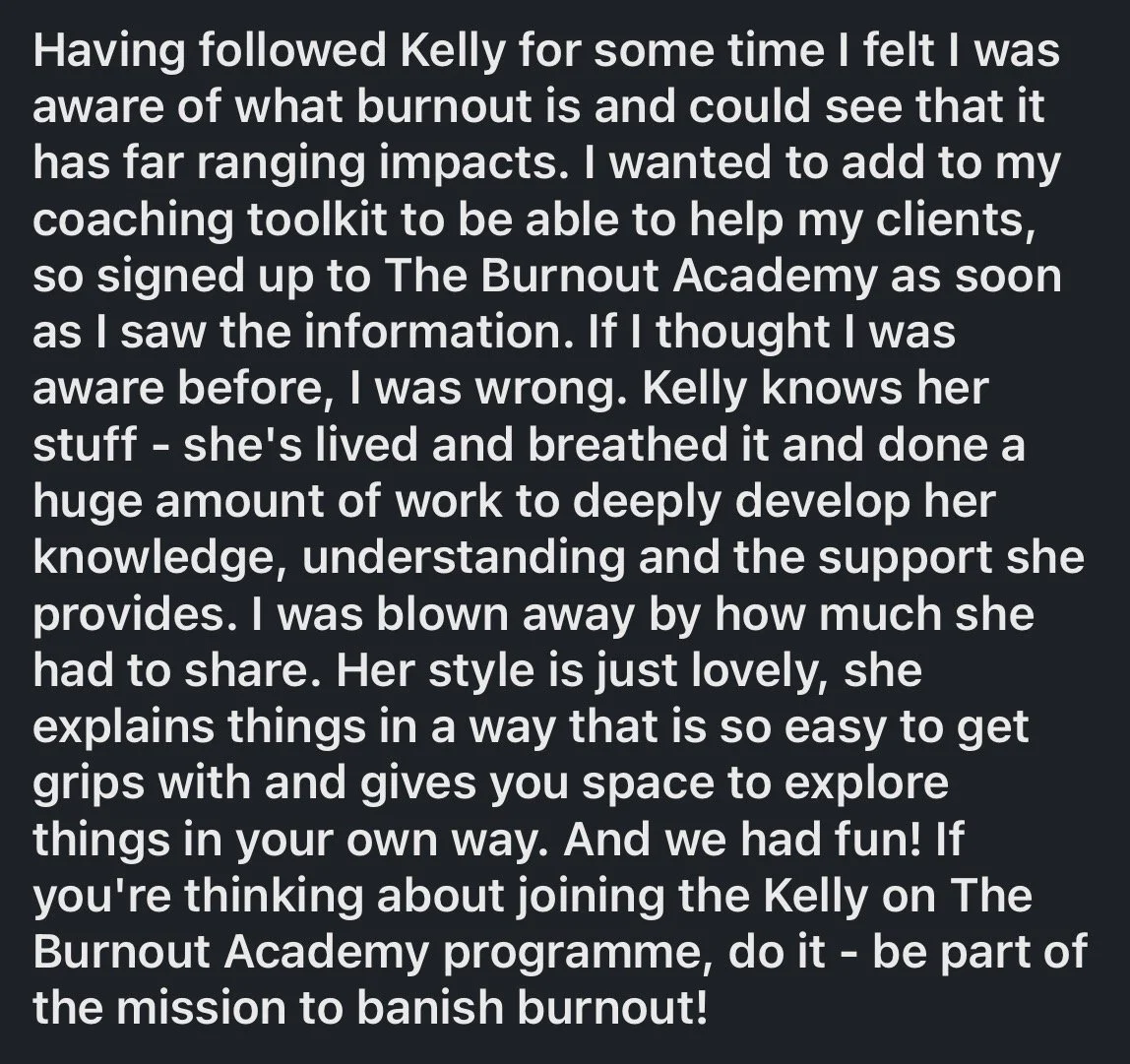
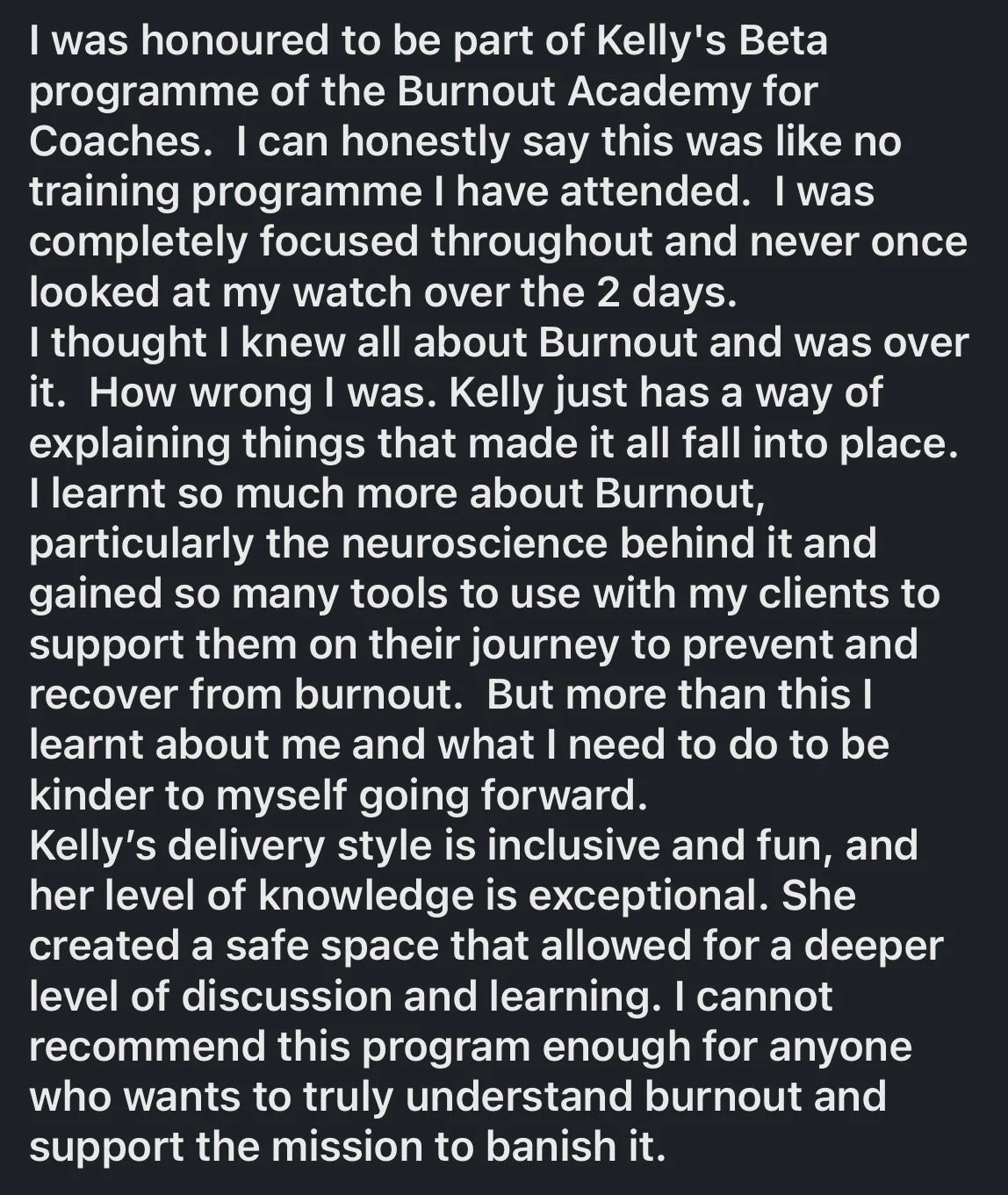
I can honestly say this was like no training programme I have attended. I was completely focused throughout and never once looked at my watch over the 2 days. I thought I knew all about Burnout and was over it. How wrong I was. Kelly just has a way of explaining things that made it all fall into place. I learnt so much more about Burnout, particularly the neuroscience behind it and gained so many tools to use with my clients to support them on their journey to prevent and recover from burnout. But more than this I learnt about me and what I need to do to be kinder to myself going forward. Kelly’s delivery style is inclusive and fun, and her level of knowledge is exceptional. She created a safe space that allowed for a deeper level of discussion and learning. I cannot recommend this program enough for anyone who wants to truly understand burnout and support the mission to banish it.
Lorraine Eivers.
-
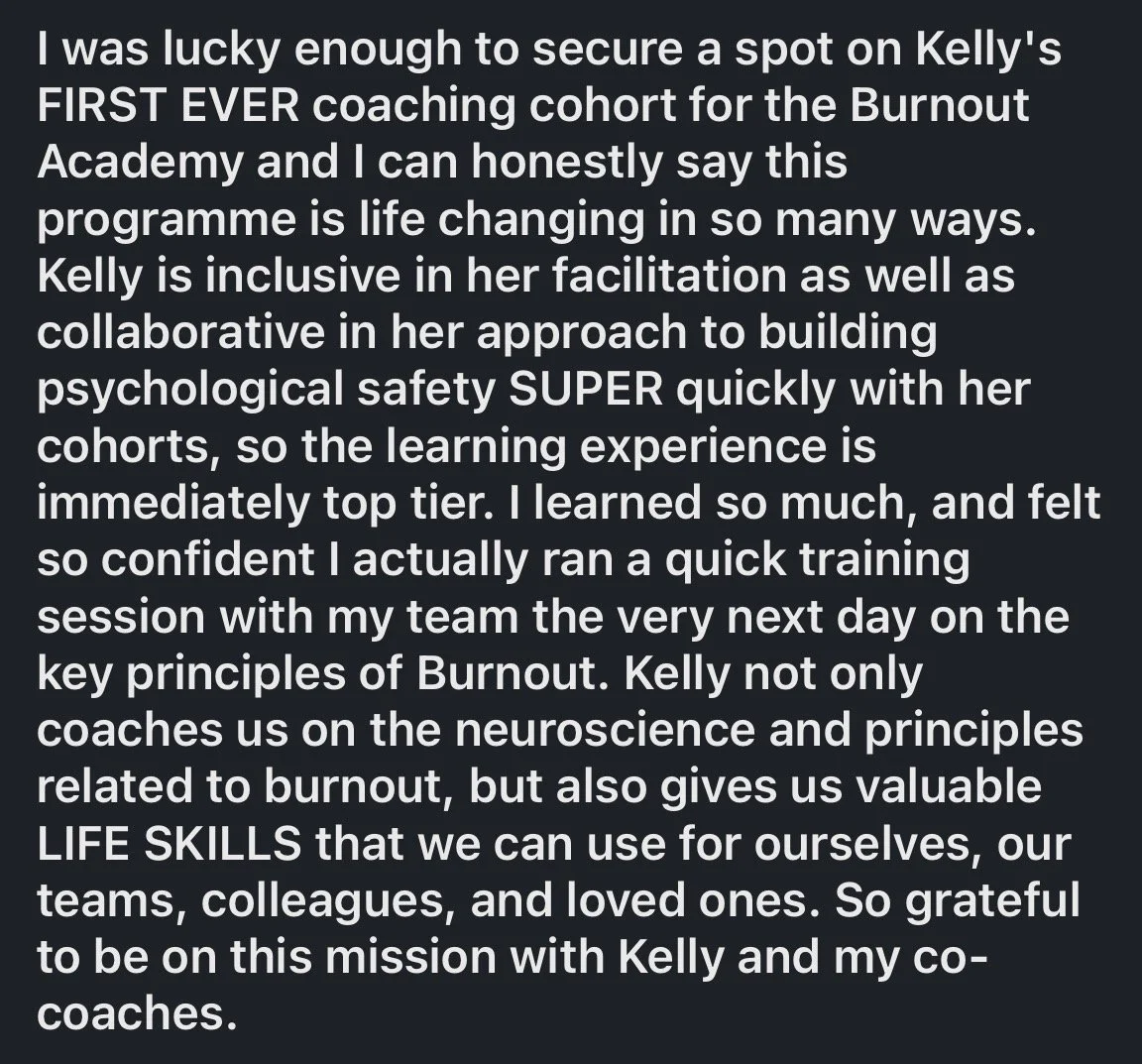
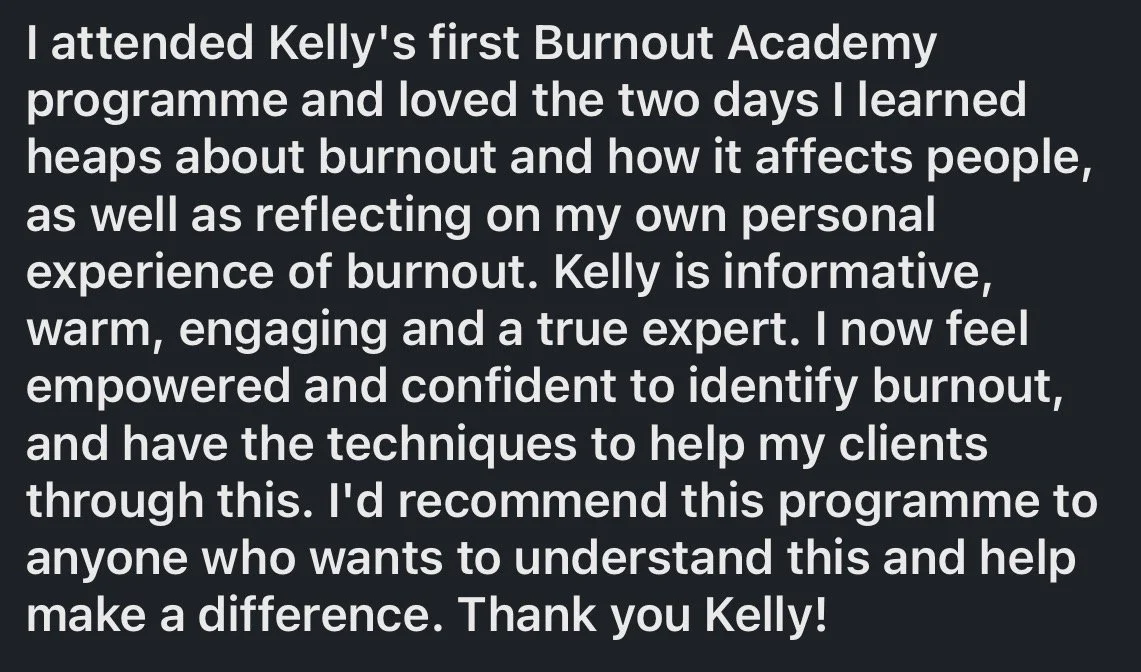
I attended Kelly's first Burnout Academy programme and loved the two days I learned heaps about burnout and how it affects people, as well as reflecting on my own personal experience of burnout. Kelly is informative, warm, engaging and a true expert. I now feel empowered and confident to identify burnout, and have the techniques to help my clients through this. I'd recommend this programme to anyone who wants to understand this and help make a difference. Thank you Kelly!
Louise Demetriou.

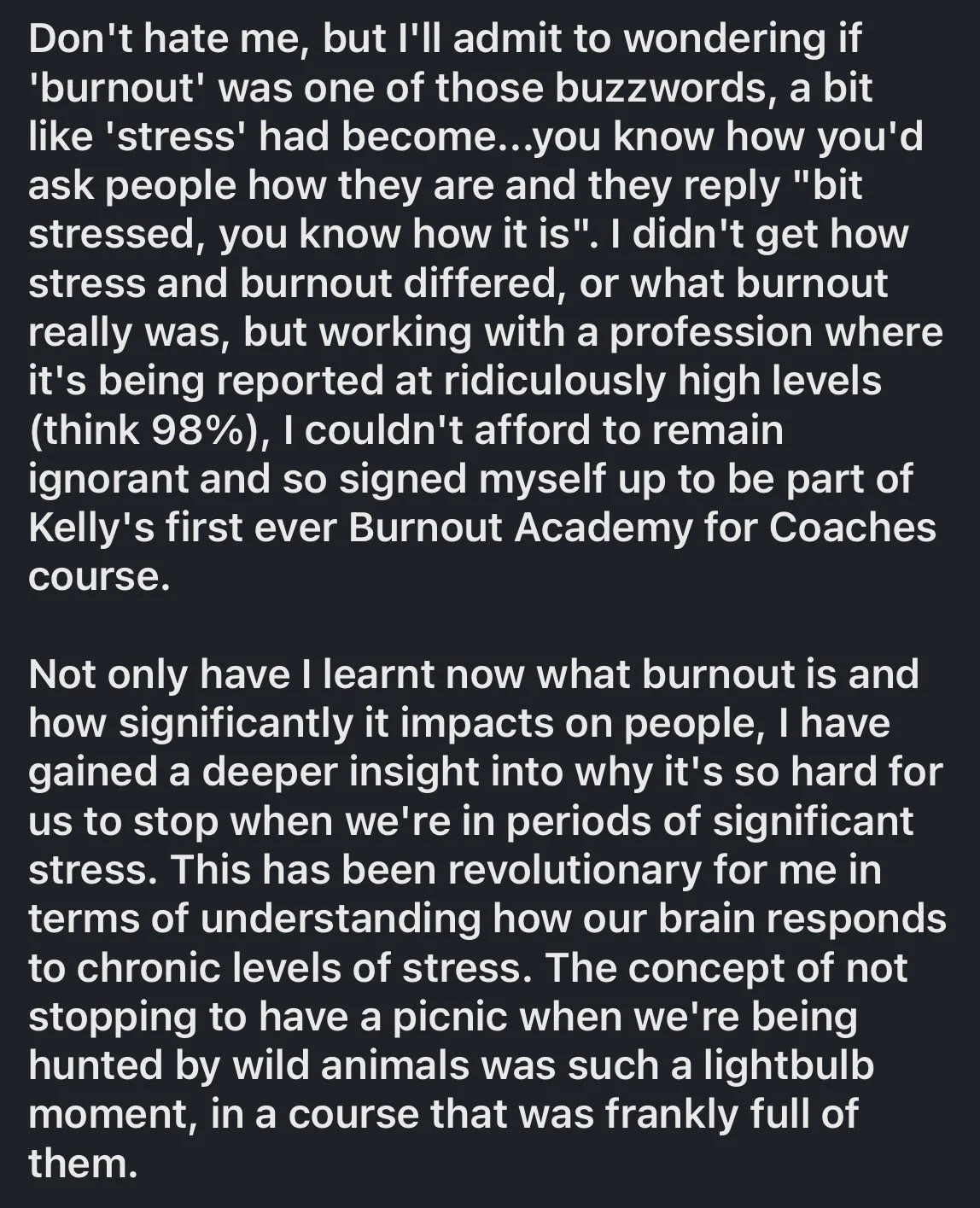
“Not only have I learnt now what burnout is and how significantly it impacts on people, I have gained a deeper insight into why it's so hard for us to stop when we're in periods of significant stress. This has been revolutionary for me in terms of understanding how our brain responds to chronic levels of stress. The concept of not stopping to have a picnic when we're being hunted by wild animals was such a lightbulb moment, in a course that was frankly full of them. ”
EMMA DJEMIL